Well, today is the last day of Spring Break. I’m back home in Austin, having spent most of the week with my family in Phoenix, and trying (in vain) to catch up on all the work I SHOULD have been doing. Spring break is always like this (at least for me.) You set yourself all of these goals and then achieve none of them. This break, my goal was to read a few Jose Cruz Gonzalez plays, in preparation for a paper I’m writing this week comparing his work to Suzan Zeder’s work. You can imagine how well THAT turned out. So far, my thesis is both authors have a number of Z’s in their names...
I did manage to achieve one goal (of course, the one that was completely un-work-related.) I read a pleasure book. A whole book! Actually, I read one and a half. I managed to finish Alexander McCall Smith’s 44 Scotland Street, a novel I’ve been working on since August. I highly recommend it. If you’re the sort of person who enjoys character-centered stories filled with quirky, humorous personalities and just enough plot to keep the whole thing interesting, Alexander McCall Smith is your man. He’s written several series, but the Scotland Street novels are definitely my favorite. They come with the added bonus that they’re written in an episodic manner, so you can read a few chapters at Christmas and return to it over Spring Break without needing to remember exactly which plot developments you read 2 months ago.
The main book of the break was Calvin Trillin’s Travels with Alice. This book has been at the top of my “read me” list for years now, and I finally got around to reading it. I’m so glad I did. Calvin Trillin strikes me as the sort of person I’d really like to have a meal with, maybe wander through a European market remarking on the annoying presence of non-edible items like mops and gathering cheese, bread, and olives for a picnic by a lake in Tuscany.
Dan Cryer from Newsday describes Trillin as, “The sophisticated traveler masquerading as the innocent abroad,” but I don’t think this fully captures the odd mix of sophistication and insanity that Travels with Alice seems to hold at its heart. Anyone who can eat about 8 fast-food burgers and french fries in one afternoon (in the name of “assessing the authenticity of French Fast Food restaurants), enjoy a game that essentially involves tricking a bull into standing in a paddling pool, play a rousing game of fooseball (called babyfoot in France) in the local bar, and then trot off to the local market to sample fresh fruits and vegetables, pastries, and cheeses all in the same trip is definitely insane in a fantastic sort of way. He’s exactly the sort of person I’d love to go on a trip with.
There’s something paradoxically sophisticated and simple about the way Calvin Trillin describes his vacations abroad. He’s one of the few writers I’ve ever encountered that would seem equally at home in a dive-bar that just happens to have the best seafood this side of the atlantic, and a restaurant in Paris that won’t let you in unless you’re wearing a tuxedo. I really admire that kind of flexibility, and it definitely makes for an interesting read. It also helps that Calving Trillin is HILARIOUS. (For proof I point you to the chapter entitled “Beach Picnic” where Trillin contemplates bringing an entire ham, which at the time was hanging from a peg in the ceiling of his living room, to a trip to one of the British Virgin Islands, known for its beaches, but not for its food. He ends up leaving the ham at home, at the behest of his wife, but they do bring an entire suitcase full of provisions.)
The best thing about this book is that it got me thinking about some of the places I’ve been. Calvin Trillin tells his stories in such a natural way you feel like you’re sitting in his living room (under the ham) hearing stories about his family’s latest exploits, and gearing up to tell a few stories of your own. His tales of exploring the Mercato Centrale in Florence reminded me of my own experiences there (he even mentioned the incredible, overpowering smell of meat that hits you when you enter the market, one of my chief memories of that place), and his stories about France actually invited me to fantasize about returning to Paris, even though my experience there wasn’t always positive (not being able to speak french makes it difficult to enjoy France.) If you’re looking for a book that will take you on a journey, that will make you laugh, and that won’t take you long to read, Travels with Alice should definitely be on your “read me” list.
Sunday, March 20, 2011

Friday, February 4, 2011
Driving in Inclement Weather (Or: Step 1--yell obscenities at the car in front of you doing 10 mph because there’s 3 centimeters of snow on the ground.)
It snowed in Austin today. I gather that this is a relatively rare occurrence. How did I figure this out? Well, it could be my amazing, Holmesian powers of deduction, or it could be the amount of freaking out that occurred over the past 3 days. Allow me to recap for you.
On Tuesday, the temperature plummeted from it's-starting-to-feel-like-spring to oh-my-god-why-can’t-I-feel-my-fingers. For the rest of the week, the overtaxed power grid struggled to cope with the sudden, overwhelming strain placed on it by countless heaters working over time, and we humans pulled out every warm item of clothing we owned (at one point I had 3 pairs of socks on: two on my feet and one on my hands.) In our defense, it was genuinely cold. I can’t remember the last time I was actually out in single digit weather. Then (cue dramatic music) the weather channel said the S word. Snow, beginning Thursday night and stretching into Friday. An atmosphere of vague panic descended on the city on Wednesday, and by Thursday afternoon it had gelled into genuine fear. While Chicago prepared for Snowpocalypse 2011, Austin prepared for Snowpocalito, its annoying younger brother.
I didn’t actually get to see the snow fall. It happened late last night. When I woke up this morning there was a fine dusting of snow, perhaps an inch thick at the most, covering everything. The university canceled classes, businesses declared a holiday, even the US postal service declared a no-mail day due to “inclement weather.” Now I spent a good part of my childhood living in the south where a forecast of snow sent most of our neighbors scrambling to Walmart to stock up on toilet paper and milk (why toilet paper and milk I will never know...) but I have never encountered anything close to the amount of panic that inch of snow caused in Austin today. Just for fun, I went out driving at about 10 am. I’ve never driven in snow before (I learned to drive in the Sonoran Desert) and while I know the theory (having spent years listening to my parents shout it angrily at the cars in front of us on snowy days in North Carolina) I’ve never actually put the theory into practice. I did a little research to brush myself up on what to do if the car skids, bundled up, brushed off my windshield, warmed up my car and set out. Much to my disappointment, I didn’t skid. Not even close. I did, however, encounter the unique frustration of being surrounded by completely clueless drivers. I feel entirely in my rights to complain about bad snow driving, seeing as I LEARNED TO DRIVE IN THE DESERT. I understand the dangers, and I don’t mean to belittle the actions taken by the university (I have seen too many tragedies caused by dedicated students trying to drive to school in snowy conditions they just don’t know how to handle) but really. There’s no need to panic. Simply drive at a speed at which you feel you have good control over your car (that does NOT mean 10 miles an hour), leave plenty of follow space between yourself and the car in front of you (That’s difficult, I know), and if you don’t think you can handle it, don’t drive.
To those of you who are well and truly snowed in, stay warm, stay safe, and enjoy your milk and toilet paper.
On Tuesday, the temperature plummeted from it's-starting-to-feel-like-spring to oh-my-god-why-can’t-I-feel-my-fingers. For the rest of the week, the overtaxed power grid struggled to cope with the sudden, overwhelming strain placed on it by countless heaters working over time, and we humans pulled out every warm item of clothing we owned (at one point I had 3 pairs of socks on: two on my feet and one on my hands.) In our defense, it was genuinely cold. I can’t remember the last time I was actually out in single digit weather. Then (cue dramatic music) the weather channel said the S word. Snow, beginning Thursday night and stretching into Friday. An atmosphere of vague panic descended on the city on Wednesday, and by Thursday afternoon it had gelled into genuine fear. While Chicago prepared for Snowpocalypse 2011, Austin prepared for Snowpocalito, its annoying younger brother.
I didn’t actually get to see the snow fall. It happened late last night. When I woke up this morning there was a fine dusting of snow, perhaps an inch thick at the most, covering everything. The university canceled classes, businesses declared a holiday, even the US postal service declared a no-mail day due to “inclement weather.” Now I spent a good part of my childhood living in the south where a forecast of snow sent most of our neighbors scrambling to Walmart to stock up on toilet paper and milk (why toilet paper and milk I will never know...) but I have never encountered anything close to the amount of panic that inch of snow caused in Austin today. Just for fun, I went out driving at about 10 am. I’ve never driven in snow before (I learned to drive in the Sonoran Desert) and while I know the theory (having spent years listening to my parents shout it angrily at the cars in front of us on snowy days in North Carolina) I’ve never actually put the theory into practice. I did a little research to brush myself up on what to do if the car skids, bundled up, brushed off my windshield, warmed up my car and set out. Much to my disappointment, I didn’t skid. Not even close. I did, however, encounter the unique frustration of being surrounded by completely clueless drivers. I feel entirely in my rights to complain about bad snow driving, seeing as I LEARNED TO DRIVE IN THE DESERT. I understand the dangers, and I don’t mean to belittle the actions taken by the university (I have seen too many tragedies caused by dedicated students trying to drive to school in snowy conditions they just don’t know how to handle) but really. There’s no need to panic. Simply drive at a speed at which you feel you have good control over your car (that does NOT mean 10 miles an hour), leave plenty of follow space between yourself and the car in front of you (That’s difficult, I know), and if you don’t think you can handle it, don’t drive.
To those of you who are well and truly snowed in, stay warm, stay safe, and enjoy your milk and toilet paper.
Saturday, January 29, 2011
Gus: The Theatre Cat
When I was little, I used to love hearing my dad read poems from T.S. Elliot’s collection Old Possum’s Book of Practical Cats. These are the poems the musical, Cats uses as its text, but in my opinion, they’re much better read as bedtime stories, particularly when it’s my dad doing the reading. We especially loved to recite “Macavity, Macavity there’s no one like Macavity...” Dad would put in funny voices for all the characters that spoke (his old man voice is hilarious) and the illustrations by Edward Gorey (if you watch Masterpiece Mystery, you’re familiar with his work) are delightful.
What has this to do with anything? Well, one of the poems is called “Gus: The Theatre Cat.” And when I adopted a cat from the shelter yesterday, there was only one name suitable for him. Asparagus, or Gus, for short. (In the poem, you see, Elliot explains that Gus’s real name is “Asparagus” but that’s such a fuss/to pronounce that we usually call him just Gus.)
My Gus, the theatre cat even has a bit of an air of an Edward Gorey illustration about him. He’s all black except for striking yellow eyes and two white whiskers on the right side of his face. The whiskers, in particular, give him a certain... Gorey-ness.
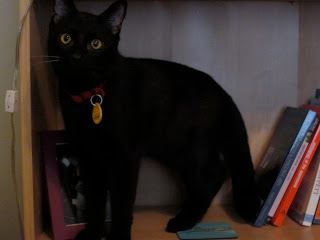
I have been contemplating adopting a cat for a long time. I started thinking about it almost as soon as I found out I had been accepted to UT Austin. I had to do some real thinking and planning, though, to make sure I could financially and emotionally support a cat. Now that I have, I already couldn’t imagine life without him (I’ve had him for two days.)
The final deciding factor was finding out about the program Austin Pets Alive!, an animal rescue service that takes cats from the local shelters’ euthanasia lists, boards them in kennels and foster care, and adopts them out to worthy families. Pets Alive! is an incredibly supportive adoption facility, and as a new pet owner, I feel so confident knowing I can contact their animal behaviorist with questions free of charge. They even pay for all of Gus’s shots, his neuter surgery, a microchip, and a month’s worth of pet insurance (which will be useful, as I was considering getting pet insurance, and this will be a great way to try it out.) They are a really, really great adoption service and I’m proud to have supported their efforts.
Gus is adjusting extremely well to his new home. So far, there has been an almost suspicious lack of problems. He uses his litter box just fine (even manages to be a relatively tidy litter user in spite of the fact that he has to spend 15 minutes interior decorating before each poo), he hasn’t scratched the furniture, doors, walls, or floor, and he isn’t too much of a nuisance at night. He likes to be near people, following me around the house (occasionally yowling to let me know I’m not paying proper attention to him). He’s not a lap cat, but he’s sleeping right next to me while I write this. He’s absolutely wild about chasing bits of string. I bought him one of those sticks with a feather at the end, and we happily played with it together for a solid hour and a half (and only stopped because I got tired.) I think my strategy to keep him entertained while I’m doing homework will be to balance his feather toy on the couch next to me so it dangles down and he can bat at it to his heart’s content without feeling neglected.
That's all for now. I’m sure in the future there will be many more Gus stories. He’s the only thing I talk about right now. I’m trying hard not to be annoying about it. Maybe this will get it all out of my system... Probably not.
Gus: The Theatre Cat
Gus is the Cat at the Theatre Door.
His name, as I ought to have told you before,
Is really Asparagus. But that's such a fuss
To pronounce, that we usually call him just Gus.
His coat's very shabby, he's thin as a rake,
And he suffers from palsy that makes his paw shake.
Yet he was, in his youth, quite the smartest of Cats--
But no longer a terror to mice and to rats.
For he isn't the Cat that he was in his prime;
Though his name was quite famous, he says, in its time.
And whenever he joins his friends at their club
(Which takes place at the back of the neighbouring pub)
He loves to regale them, if someone else pays,
With anecdotes drawn from his palmiest days.
For he once was a Star of the highest degree--
He has acted with Irving, he's acted with Tree.
And he likes to relate his success on the Halls,
Where the Gallery once gave him seven cat-calls.
But his grandest creation, as he loves to tell,
Was Firefrorefiddle, the Fiend of the Fell.
"I have played," so he says, "every possible part,
And I used to know seventy speeches by heart.
I'd extemporize back-chat, I knew how to gag,
And I knew how to let the cat out of the bag.
I knew how to act with my back and my tail;
With an hour of rehearsal, I never could fail.
I'd a voice that would soften the hardest of hearts,
Whether I took the lead, or in character parts.
I have sat by the bedside of poor Little Nell;
When the Curfew was rung, then I swung on the bell.
In the Pantomime season I never fell flat,
And I once understudied Dick Whittington's Cat.
But my grandest creation, as history will tell,
Was Firefrorefiddle, the Fiend of the Fell."
Then, if someone will give him a toothful of gin,
He will tell how he once played a part in East Lynne.
At a Shakespeare performance he once walked on pat,
When some actor suggested the need for a cat.
He once played a Tiger--could do it again--
Which an Indian Colonel purused down a drain.
And he thinks that he still can, much better than most,
Produce blood-curdling noises to bring on the Ghost.
And he once crossed the stage on a telegraph wire,
To rescue a child when a house was on fire.
And he says: "Now then kittens, they do not get trained
As we did in the days when Victoria reigned.
They never get drilled in a regular troupe,
And they think they are smart, just to jump through a hoop."
And he'll say, as he scratches himself with his claws,
"Well, the Theatre's certainly not what it was.
These modern productions are all very well,
But there's nothing to equal, from what I hear tell,
That moment of mystery
When I made history
As Firefrorefiddle, the Fiend of the Fell."
note: If you like this poem, be sure to check out Old Possum’s Book of Practical Cats!
What has this to do with anything? Well, one of the poems is called “Gus: The Theatre Cat.” And when I adopted a cat from the shelter yesterday, there was only one name suitable for him. Asparagus, or Gus, for short. (In the poem, you see, Elliot explains that Gus’s real name is “Asparagus” but that’s such a fuss/to pronounce that we usually call him just Gus.)
My Gus, the theatre cat even has a bit of an air of an Edward Gorey illustration about him. He’s all black except for striking yellow eyes and two white whiskers on the right side of his face. The whiskers, in particular, give him a certain... Gorey-ness.

Gus: The Theatre Cat
I have been contemplating adopting a cat for a long time. I started thinking about it almost as soon as I found out I had been accepted to UT Austin. I had to do some real thinking and planning, though, to make sure I could financially and emotionally support a cat. Now that I have, I already couldn’t imagine life without him (I’ve had him for two days.)
The final deciding factor was finding out about the program Austin Pets Alive!, an animal rescue service that takes cats from the local shelters’ euthanasia lists, boards them in kennels and foster care, and adopts them out to worthy families. Pets Alive! is an incredibly supportive adoption facility, and as a new pet owner, I feel so confident knowing I can contact their animal behaviorist with questions free of charge. They even pay for all of Gus’s shots, his neuter surgery, a microchip, and a month’s worth of pet insurance (which will be useful, as I was considering getting pet insurance, and this will be a great way to try it out.) They are a really, really great adoption service and I’m proud to have supported their efforts.
Gus is adjusting extremely well to his new home. So far, there has been an almost suspicious lack of problems. He uses his litter box just fine (even manages to be a relatively tidy litter user in spite of the fact that he has to spend 15 minutes interior decorating before each poo), he hasn’t scratched the furniture, doors, walls, or floor, and he isn’t too much of a nuisance at night. He likes to be near people, following me around the house (occasionally yowling to let me know I’m not paying proper attention to him). He’s not a lap cat, but he’s sleeping right next to me while I write this. He’s absolutely wild about chasing bits of string. I bought him one of those sticks with a feather at the end, and we happily played with it together for a solid hour and a half (and only stopped because I got tired.) I think my strategy to keep him entertained while I’m doing homework will be to balance his feather toy on the couch next to me so it dangles down and he can bat at it to his heart’s content without feeling neglected.
That's all for now. I’m sure in the future there will be many more Gus stories. He’s the only thing I talk about right now. I’m trying hard not to be annoying about it. Maybe this will get it all out of my system... Probably not.
Gus: The Theatre Cat
Gus is the Cat at the Theatre Door.
His name, as I ought to have told you before,
Is really Asparagus. But that's such a fuss
To pronounce, that we usually call him just Gus.
His coat's very shabby, he's thin as a rake,
And he suffers from palsy that makes his paw shake.
Yet he was, in his youth, quite the smartest of Cats--
But no longer a terror to mice and to rats.
For he isn't the Cat that he was in his prime;
Though his name was quite famous, he says, in its time.
And whenever he joins his friends at their club
(Which takes place at the back of the neighbouring pub)
He loves to regale them, if someone else pays,
With anecdotes drawn from his palmiest days.
For he once was a Star of the highest degree--
He has acted with Irving, he's acted with Tree.
And he likes to relate his success on the Halls,
Where the Gallery once gave him seven cat-calls.
But his grandest creation, as he loves to tell,
Was Firefrorefiddle, the Fiend of the Fell.
"I have played," so he says, "every possible part,
And I used to know seventy speeches by heart.
I'd extemporize back-chat, I knew how to gag,
And I knew how to let the cat out of the bag.
I knew how to act with my back and my tail;
With an hour of rehearsal, I never could fail.
I'd a voice that would soften the hardest of hearts,
Whether I took the lead, or in character parts.
I have sat by the bedside of poor Little Nell;
When the Curfew was rung, then I swung on the bell.
In the Pantomime season I never fell flat,
And I once understudied Dick Whittington's Cat.
But my grandest creation, as history will tell,
Was Firefrorefiddle, the Fiend of the Fell."
Then, if someone will give him a toothful of gin,
He will tell how he once played a part in East Lynne.
At a Shakespeare performance he once walked on pat,
When some actor suggested the need for a cat.
He once played a Tiger--could do it again--
Which an Indian Colonel purused down a drain.
And he thinks that he still can, much better than most,
Produce blood-curdling noises to bring on the Ghost.
And he once crossed the stage on a telegraph wire,
To rescue a child when a house was on fire.
And he says: "Now then kittens, they do not get trained
As we did in the days when Victoria reigned.
They never get drilled in a regular troupe,
And they think they are smart, just to jump through a hoop."
And he'll say, as he scratches himself with his claws,
"Well, the Theatre's certainly not what it was.
These modern productions are all very well,
But there's nothing to equal, from what I hear tell,
That moment of mystery
When I made history
As Firefrorefiddle, the Fiend of the Fell."
note: If you like this poem, be sure to check out Old Possum’s Book of Practical Cats!
Monday, January 24, 2011
"I haven't heard of that guy"
Ok, I confess it. When I posted a facebook status a couple of days ago celebrating that I had met Jose Cruz Gonzales, I did it partly as an experiment to see how many of my friends had actually heard of him. I was not surprised to find out that none of them (not even my father, who knows everything) know who he is. Do you?
If you do, it's probably because you have either a) been to a production of one of his plays at Childsplay in Arizona, or b) Studied Theatre for Youth. Jose Cruz Gonzales is one of the most prolific playwrights of theatre for youth (another being Suzan Zeder, a professor here at UT Austin). His work is especially exciting to me, as he writes bilingual and trilingual plays. Many of his works reflect his hispanic heritage, incorprating elements of magical realism seamlessly into the plot. Meeting him and speaking to him about language was thrilling.
Theatre for Youth is a very young field. Perhaps that is why its heroes are practically unknown to the general public. Who among you have heard of Dorothy Heathcote or Aurand Harris? You may never have heard the name "Winifred Ward" (unless you went to Northwestern) but she is the George Washington of Theatre for Youth, the woman largely responsible for shaping the field into what it is today. She's one of my heroes. If you've never heard of her, look her up.
There is another, darker reason why you may be unfamiliar with most of these names, and any teacher (especially arts teachers) will relate to it. After all, those who can, do, and those who can't, teach, right? For some reason Americans tend to think that because they are children, we can get away with presenting young audiences with bad theatre. "It doesn't matter, they won't notice. They're just kids." It's a deplorable attitude. We expect the very best out of our schools, so why, when those same students enter the theatre, are we content with mediocrity? These students deserve better. They deserve to see high-quality, well-written, and well-produced productions designed specifically to address the issues they deal with and portray the world they live in. I have seen to much "children's theatre" where the plot is obvious, formulaic, even insulting, and the production value is shockingly low. I challenge you to become familiar with the names I have given. Find out if there is a play by Jose Cruz Gonzales being produced in your community. If not, why not? It is not enough that those very few of us in the field of theatre for youth are asking these questions. We must, as a society, demand better theatre.
If you do, it's probably because you have either a) been to a production of one of his plays at Childsplay in Arizona, or b) Studied Theatre for Youth. Jose Cruz Gonzales is one of the most prolific playwrights of theatre for youth (another being Suzan Zeder, a professor here at UT Austin). His work is especially exciting to me, as he writes bilingual and trilingual plays. Many of his works reflect his hispanic heritage, incorprating elements of magical realism seamlessly into the plot. Meeting him and speaking to him about language was thrilling.
Theatre for Youth is a very young field. Perhaps that is why its heroes are practically unknown to the general public. Who among you have heard of Dorothy Heathcote or Aurand Harris? You may never have heard the name "Winifred Ward" (unless you went to Northwestern) but she is the George Washington of Theatre for Youth, the woman largely responsible for shaping the field into what it is today. She's one of my heroes. If you've never heard of her, look her up.
There is another, darker reason why you may be unfamiliar with most of these names, and any teacher (especially arts teachers) will relate to it. After all, those who can, do, and those who can't, teach, right? For some reason Americans tend to think that because they are children, we can get away with presenting young audiences with bad theatre. "It doesn't matter, they won't notice. They're just kids." It's a deplorable attitude. We expect the very best out of our schools, so why, when those same students enter the theatre, are we content with mediocrity? These students deserve better. They deserve to see high-quality, well-written, and well-produced productions designed specifically to address the issues they deal with and portray the world they live in. I have seen to much "children's theatre" where the plot is obvious, formulaic, even insulting, and the production value is shockingly low. I challenge you to become familiar with the names I have given. Find out if there is a play by Jose Cruz Gonzales being produced in your community. If not, why not? It is not enough that those very few of us in the field of theatre for youth are asking these questions. We must, as a society, demand better theatre.
Wednesday, January 12, 2011
On Leaving Home
I am headed back to Austin today after a long, relaxing break, and I can’t help feeling a little sad. Not that I don’t love living in Austin, or that I’m not enjoying the grad program at UT; I am, and I’m anxious to return. There’s a lot waiting for me in Austin: A move to a new apartment, the beginning of a new, exciting job, the preparations for a conference in Tampa I’ll be attending next week... but its never easy to leave home regardless of how much I might enjoy the destination.
I realized as I was trying to sleep last night, stuck helplessly going over all the various items on my to do list (the way you do when you’re slightly stressed, but not sure exactly what you’re stressed about), that I’m out of practice in dealing with the conflicting emotions involved in a return to school. There is something wildly different about returning to school after a long break versus returning to work (even if that work happens to be teaching in school). There is anticipation: each semester is a new and different animal. With the change of classes comes a change of work-load and responsibility that I always find my self both eagerly anticipating and dreading. There is also a certain nostalgia: Christmas is over and there is still the long stretch of January and February ahead before we can begin to think about spring. I find this is true, even in climates where late winter is one of the most pleasant times of the year. There is also the inevitable sadness of having to leave my family behind again. We are extremely close, the four of us, and no matter how many times I’ve done it, it never gets easier to wave goodbye to them at the airport. For people who grow up in houses that they can’t wait to leave, this can be hard to understand. It might seem as ridiculous as Michael Palin insisting to a stunned John Cleese that his dead parrot is merely “Pinin’ for the fjords.” To me, however, leaving my family behind is one of the most difficult things about the return to school.
Paradoxically, I think it is actually easier to be the person doing the leaving. Regardless of how much I might dread saying goodbye to my father and sister in the airport in a few hours, I would much rather be the person waving a tearful goodbye while trying to navigate the increasingly complicated security screening than the person being left behind. I discovered this last year when, in a strange twist, I stayed in Phoenix while Dad and Miriam left. I’m not sure exactly why this is, but I suspect it has something to do with all those conflicting emotions I mentioned. When I’m leaving to go back to school, there is always that anxious anticipation to temper the homesickness.
So here’s hoping that where ever you are and where ever your travels might take you, you embark on the journey with a healthy mix of excitement and sadness. May the road rise up to meet you.
I realized as I was trying to sleep last night, stuck helplessly going over all the various items on my to do list (the way you do when you’re slightly stressed, but not sure exactly what you’re stressed about), that I’m out of practice in dealing with the conflicting emotions involved in a return to school. There is something wildly different about returning to school after a long break versus returning to work (even if that work happens to be teaching in school). There is anticipation: each semester is a new and different animal. With the change of classes comes a change of work-load and responsibility that I always find my self both eagerly anticipating and dreading. There is also a certain nostalgia: Christmas is over and there is still the long stretch of January and February ahead before we can begin to think about spring. I find this is true, even in climates where late winter is one of the most pleasant times of the year. There is also the inevitable sadness of having to leave my family behind again. We are extremely close, the four of us, and no matter how many times I’ve done it, it never gets easier to wave goodbye to them at the airport. For people who grow up in houses that they can’t wait to leave, this can be hard to understand. It might seem as ridiculous as Michael Palin insisting to a stunned John Cleese that his dead parrot is merely “Pinin’ for the fjords.” To me, however, leaving my family behind is one of the most difficult things about the return to school.
Paradoxically, I think it is actually easier to be the person doing the leaving. Regardless of how much I might dread saying goodbye to my father and sister in the airport in a few hours, I would much rather be the person waving a tearful goodbye while trying to navigate the increasingly complicated security screening than the person being left behind. I discovered this last year when, in a strange twist, I stayed in Phoenix while Dad and Miriam left. I’m not sure exactly why this is, but I suspect it has something to do with all those conflicting emotions I mentioned. When I’m leaving to go back to school, there is always that anxious anticipation to temper the homesickness.
So here’s hoping that where ever you are and where ever your travels might take you, you embark on the journey with a healthy mix of excitement and sadness. May the road rise up to meet you.
Saturday, January 8, 2011
Layout Change
Yes, the layout has changed. It's criminally easy to do, and I decided I wanted the blog design to focus on the actual entries rather than an eye-bleeding pattern. If you have any comments or suggestions about the layout, please let me know. I have complete control over things like font, text size, color, etc. So if something makes the text hard to see on your computer, please let me know!
Concerning an Annual Conundrum
Every year around this time I come up against the same question: to resolve or not to resolve? More specifically, do I make a New Year’s resolution this year, or do I give up on the idea altogether (before I have a chance to break that noble resolution)?
Normally I’d almost immediately jump to the “give up” part, but this year, having spent a semester talking about setting goals in grad school, I’m starting to think that setting a few attainable goals for the year isn’t too horrible an idea.
That then raises the question, “Which goal?” For help, I google searched “Top 10 New Year’s resolutions, 2011” to see what other people are doing. The results were unsurprising, but disappointing. Most had something about loosing weight, which is always one of my goals (so why bother making it a New Year’s resolution?). “Getting organized” was also popular, generally followed by “Procrastinate less” (this makes me feel much better, knowing the rest of the world is just as disorganized as I am, and just as liable to put off eventually getting organized...). Of course, I promised myself I’d set attainable goals, and let’s be honest, organizing my life isn’t a really attainable goal. I thrive in semi-organized chaos. Most lists also included something along the lines of “enjoying life” which just seems like a cop-out. Identify what it is that’s preventing you from enjoying life and change that. I don’t intend to waste my time with vague, sappy resolutions.
So we’re back at square one. Clearly, google doesn’t think about New Year’s resolutions the same way I do. However, after some careful consideration, I have come up with 3 goals for the New Year that I think I can accomplish:
Maintain a daily yoga practice. “A daily yoga practice” could mean any number of things. I do intend to participate in the 40 day challenge again next year, but the rest of the time I try to practice yoga in the studio at least 3 times a week. I start most mornings with a short set of sun salutations, meeting the “daily yoga practice” goal in a way I might actually be able to maintain. I should also mention that I’m supplementing the yoga with some more aerobic walking and jogging.
Keep in contact with friends and family. This is my one concession to google’s “top 10” lists, but I’m REALLY bad at calling people. Everyone who knows me knows this. I absolutely hate talking on the phone, and I use that as an excuse to just... not do it. Well, friends, this year, I’m going to fail equally badly at calling you, but I’m trying to change my ways. Luckily, we also have email, skype, facebook, and all sorts of other ways to keep in contact.
Learn how to bake a superb pie crust. This will probably be my summer project.
Well, there you have it. Notice there’s nothing about grad school or future career goals in there. I figure I’ll be setting enough of those types of goals through my grad school program that I could drive myself crazy if I try doing it for New Year too. We’ll see how well I do.
Happy New Year!
Normally I’d almost immediately jump to the “give up” part, but this year, having spent a semester talking about setting goals in grad school, I’m starting to think that setting a few attainable goals for the year isn’t too horrible an idea.
That then raises the question, “Which goal?” For help, I google searched “Top 10 New Year’s resolutions, 2011” to see what other people are doing. The results were unsurprising, but disappointing. Most had something about loosing weight, which is always one of my goals (so why bother making it a New Year’s resolution?). “Getting organized” was also popular, generally followed by “Procrastinate less” (this makes me feel much better, knowing the rest of the world is just as disorganized as I am, and just as liable to put off eventually getting organized...). Of course, I promised myself I’d set attainable goals, and let’s be honest, organizing my life isn’t a really attainable goal. I thrive in semi-organized chaos. Most lists also included something along the lines of “enjoying life” which just seems like a cop-out. Identify what it is that’s preventing you from enjoying life and change that. I don’t intend to waste my time with vague, sappy resolutions.
So we’re back at square one. Clearly, google doesn’t think about New Year’s resolutions the same way I do. However, after some careful consideration, I have come up with 3 goals for the New Year that I think I can accomplish:
Maintain a daily yoga practice. “A daily yoga practice” could mean any number of things. I do intend to participate in the 40 day challenge again next year, but the rest of the time I try to practice yoga in the studio at least 3 times a week. I start most mornings with a short set of sun salutations, meeting the “daily yoga practice” goal in a way I might actually be able to maintain. I should also mention that I’m supplementing the yoga with some more aerobic walking and jogging.
Keep in contact with friends and family. This is my one concession to google’s “top 10” lists, but I’m REALLY bad at calling people. Everyone who knows me knows this. I absolutely hate talking on the phone, and I use that as an excuse to just... not do it. Well, friends, this year, I’m going to fail equally badly at calling you, but I’m trying to change my ways. Luckily, we also have email, skype, facebook, and all sorts of other ways to keep in contact.
Learn how to bake a superb pie crust. This will probably be my summer project.
Well, there you have it. Notice there’s nothing about grad school or future career goals in there. I figure I’ll be setting enough of those types of goals through my grad school program that I could drive myself crazy if I try doing it for New Year too. We’ll see how well I do.
Happy New Year!
Subscribe to:
Posts (Atom)