When I am asked, “Are you Jewish?” I usually say, “I am culturally Jewish.” I come from a household that is half Jewish, half Christian, and mostly Atheist. I grew up celebrating both Jewish and Christian holidays, and for the first several years of my life I didn’t quite understand the difference between Judaism and Christianity. One famous Chanukah, I asked my parents if I could say the blessing as we lit the candles on the Menorah and promptly thanked God for the Baby Jesus.
Since then, I’ve managed to get the two straight and my Jewish heritage has become quite important to me. Perhaps it is a way for me to connect to my grandfather who died when I was quite young. Perhaps it is because I spent a lot of time living in places where I was the closest my friends and classmates came to a “real” Jew... whatever the reason, I tend to find myself called upon to be “Jewish” at least one or two days out of the year, generally around Passover.
This year, the Day of Jewishness was Tuesday, April 19th, the first day of Passover (the night of the 18th was the first night). On that day, I participated in a Seder and a half (the half was a presentation I gave in a class), told a story about Chelm, and danced the horah. I said blessings and sang songs in hebrew. I even cooked a potato kugel from scratch (in spite of the 95 degree weather). I always feel slightly uncomfortable, slightly guilty, wondering perhaps if I am appropriating a religion to which I have no right. But then I find myself surrounded by first-timers singing Dayenu IN HARMONY and something inside me rejoices.
There is something beautiful about Passover that calls me to be Jewish for a day. After all, the service starts with the words, “Let all who are hungry come and eat.” Every year I find myself at this table. And every year I find myself wondering if I am disgracing my ancestors by only claiming “Jewishness” a few short days out of the year. Probably so. And yet I cannot quench the desire I feel year after year to return to that hope of Passover: Next year in Jerusalem. Next year may all be free.
Peace.
Thursday, April 21, 2011

Sunday, April 17, 2011
There's Even Music at the Grocery Store

It may sound strange when I say that my new favorite place to go hear music is actually a grocery store, but take into account the fact that it’s a grocery store in Austin and it begins to make sense. There’s a Central Market (the organic and gourmet branch of the local chain) a couple blocks from my house. It’s well within walking distance, which has proved useful since I tend to shop a bit sporadically and often realize that even though I was just at the store yesterday, I need to go back today. This particular Central Market also has a rather large prepared food section that’s half-way decent and a gorgeous patio area with trees and tables where you can eat the food. On Thursdays, Fridays, Saturdays, and Sundays they have local bands playing for free outside on that patio. So you can go to the grocery store, do your shopping, buy yourself a dinner, and eat it in the afternoon sun under the shade of trees listening to FREE MUSIC. It really doesn’t get better than that.
Actually it does, because Central Market is a gathering place for all types of people: older couples sway to the strains of the local indie-rock band that happens to be playing at 6:30 on Friday and next to them, a four year old is excitedly jumping up and down while her father chases her around frantically, carrying an ice cream cone. It’s one of the best places to people watch. Today a couple who clearly were trained in ballroom dance spent the first half of the band’s set dancing really impressively and the second half teaching a bunch of thrilled children how to swing dance. This is what I love about Austin.
Sunday, April 3, 2011
Spirit Voices
The first time I heard Paul Simon’s album, Graceland, I was in a coffee shop in Mount Desert Island, Maine, called Cafe Milagro, and it felt like un milagro. Diamonds on the Soles of her Shoes was playing, and it felt like Paul Simon had written that song for me. It combined together all of my varied tastes in music into one glorious song: a simple, folk-like melody, african drums and rhythms, voices in close harmony, acoustic guitar, and poetic lyrics. I turned to my mom, who was ordering a latte, and asked, “What is this?” She told me, and I don’t think its hyperbole to say that my whole life changed.

You see, before that day in the coffee shop I hadn’t really managed to define my taste in music. Now, armed with my parents’ copy of Graceland on tape, I was able to say clearly that I liked folk music, world music, and particularly that rare, beautiful place where the two intersected. For Christmas that year, my mom gave me a three CD collection of Paul Simon’s music. I discovered Rhythm of the Saints with its South American beat and portuguese lyrics, and my conversion became complete. It may seem like a small thing to safely say “This is the kind of music I like,” but for a shy teenager stuck in that difficult place where you’re not really sure who you are, it was a moment of fantastic self-awareness, a chance to clearly define an aspect of my own personality. “I like this type of music, and I don’t care if you don’t like it.” It was a powerful feeling for me. Thanks to Paul Simon, I tend to march to the beat of my own talking drum.
Why am I throwing this out into the world seemingly at random? Two reasons: I happened to be drinking a latte in a funky locally-owned coffee shop near my house this morning when Diamonds on the Soles of her Shoes started playing, and it took me back to that day in Cafe Milagro. It also started me thinking about this past week. I just finished one of the longest, most insane weeks of my time at UT Austin: the New Works Festival. It’s a huge, week-long festival of theatre, dance, and art totally written and produced by UT faculty and students. I worked on three projects (an over-commitment, but worthwhile) and spent the week running around frantically trying to fulfill my duties to the shows I had worked on and somehow see other people’s shows at the same time. I am still overwhelmed by the sheer amount of high-quality theatre my colleagues and I produced this past week. We march to the beat of our own drum, all of us, and I feel so privileged to be able to spend my days working with such a creative, individual group of people. We have found our Graceland.

You see, before that day in the coffee shop I hadn’t really managed to define my taste in music. Now, armed with my parents’ copy of Graceland on tape, I was able to say clearly that I liked folk music, world music, and particularly that rare, beautiful place where the two intersected. For Christmas that year, my mom gave me a three CD collection of Paul Simon’s music. I discovered Rhythm of the Saints with its South American beat and portuguese lyrics, and my conversion became complete. It may seem like a small thing to safely say “This is the kind of music I like,” but for a shy teenager stuck in that difficult place where you’re not really sure who you are, it was a moment of fantastic self-awareness, a chance to clearly define an aspect of my own personality. “I like this type of music, and I don’t care if you don’t like it.” It was a powerful feeling for me. Thanks to Paul Simon, I tend to march to the beat of my own talking drum.
Why am I throwing this out into the world seemingly at random? Two reasons: I happened to be drinking a latte in a funky locally-owned coffee shop near my house this morning when Diamonds on the Soles of her Shoes started playing, and it took me back to that day in Cafe Milagro. It also started me thinking about this past week. I just finished one of the longest, most insane weeks of my time at UT Austin: the New Works Festival. It’s a huge, week-long festival of theatre, dance, and art totally written and produced by UT faculty and students. I worked on three projects (an over-commitment, but worthwhile) and spent the week running around frantically trying to fulfill my duties to the shows I had worked on and somehow see other people’s shows at the same time. I am still overwhelmed by the sheer amount of high-quality theatre my colleagues and I produced this past week. We march to the beat of our own drum, all of us, and I feel so privileged to be able to spend my days working with such a creative, individual group of people. We have found our Graceland.
Saturday, March 26, 2011
The Legend of La Llorona
I am deeply fascinated by ghost stories. It's all about allowing yourself that healthy dose of fear, that suspenseful moment where your pulse is racing and every tiny sound suddenly becomes menacing. There's something universal about the way we tell ghost stories. You turn off all the lights except for a candle or a flashlight, you sit in a close circle, huddled together to keep out the evil spirits (or just to get some moral support from your friends) and in your best "spooky" voice you whisper a story about death.
This past week I was given an assignment in a class I'm taking called "Directing New Work." We were to bring in an "experiment"--some sort of theatrical experience we've been meaning to try but have never really gotten the opportunity to attempt. So this Tuesday, on the day of my presentation, I asked the class to gather in a circle on the stage, turned off all the lights in the theatre (except for a flashlight I grabbed from the glove compartment of my car), and told a ghost story. Before I came to class, I carefully planned out what I would say. I wrote down the results and, while it's really best to hear this sort of thing told in a properly creepy tone of voice in a properly creeky room, I thought I'd post the results here so that wherever you are, you can enjoy a good ghost story. Just do me a favor. Before you read this, turn out the lights.
Maria was a young woman from a small pueblo in Mexico, but her beauty was a legend that spread far past the edges of the village. Men traveled miles and miles just to court her, but to all of them, Maria would say, “My heart belongs to another.” You see, when Maria was young, her father had hosted a wealthy man from the city. Maria fell in love with him in the short days he stayed in her house and no other man could measure up to his handsome looks and worldly conversation. Maria spent her days pining for the man she had met so long ago, and though her friends told her he would never return, she couldn’t help dream of him.
Perhaps the stars shone down on Maria, perhaps it was the devil bringing temptation, but whatever forces were at work, one starstruck day, the man of Maria’s dreams returned to the village to stay at her father’s house. He became captivated by Maria's beauty (as so often happens in stories such as these) and remained in the village to court her. In a year’s time, Maria bore him a child, a young son. She was so overjoyed by the perfect child, she turned a deaf ear to her family’s horror and the town’s condemnation. Maria expected that her suitor would ask her to marry him, now that she had borne him a son, but days went by and he said nothing. Finally, one day he disappeared and even Maria’s friends whispered that he had gone to the city, never to return.
Time passed and Maria raised her son as best she could, but it was a constant struggle for her, and she never forgot or forgave her lover for abandoning her. One twilight, Maria was wandering on the bank of the river that ran through her pueblo, her young son in her arms, when she heard the sound of an approaching carriage. She felt a deep shudder, like a premonition, running through her body as she stepped closer to the road to see who it might be.
The horses’ hooves never faltered, the carriage's wheels never caught on the rocks or the potholes in the country road, passing Maria by as if she were already a ghost, standing invisible by the side of the road. Maria’s heart broke to pieces as she watched her former suitor ride past, holding his new wife’s hand. He never spared Maria a second glance.
Maria fell into a wild rage, motivated by hate and fed by grief. In her anger and sadness she threw her son into the river. The child was far to young to swim, and by the time Maria realized what she had done, he had already disappeared, carried away by the strong current. Maria cried “Ay mi hijo, mi hijo” and her sobs were heard around the world.
No one is really certain what happened next. Some say Maria killed herself, throwing herself into the river that claimed her child. Some say nature itself killed her, dissolving the bank beneath her feet and tumbling her into the river. Still others claim that Maria stood staring at the churning water for days, weeks, and months refusing to eat, drink or sleep until she wasted away and became a spirit. And today, at twilight, you can see her wandering the banks of the rivers of the world, looking for her child.
This past week I was given an assignment in a class I'm taking called "Directing New Work." We were to bring in an "experiment"--some sort of theatrical experience we've been meaning to try but have never really gotten the opportunity to attempt. So this Tuesday, on the day of my presentation, I asked the class to gather in a circle on the stage, turned off all the lights in the theatre (except for a flashlight I grabbed from the glove compartment of my car), and told a ghost story. Before I came to class, I carefully planned out what I would say. I wrote down the results and, while it's really best to hear this sort of thing told in a properly creepy tone of voice in a properly creeky room, I thought I'd post the results here so that wherever you are, you can enjoy a good ghost story. Just do me a favor. Before you read this, turn out the lights.
The Legend of La Llorona
There are as many different versions of La Llorona's life and death as there are people who claim to have seen her. Some claim she was the innocent victim of a man's betrayal. Some claim she was a harlot who seduced and killed her lover and then drowned her children. There is only one detail on which these various stories agree: Her name was Maria. This is just one version of Maria's story, but it is the version that was told to me by someone who truly believes this woman existed and that her ghost still roams the earth.Maria was a young woman from a small pueblo in Mexico, but her beauty was a legend that spread far past the edges of the village. Men traveled miles and miles just to court her, but to all of them, Maria would say, “My heart belongs to another.” You see, when Maria was young, her father had hosted a wealthy man from the city. Maria fell in love with him in the short days he stayed in her house and no other man could measure up to his handsome looks and worldly conversation. Maria spent her days pining for the man she had met so long ago, and though her friends told her he would never return, she couldn’t help dream of him.
Perhaps the stars shone down on Maria, perhaps it was the devil bringing temptation, but whatever forces were at work, one starstruck day, the man of Maria’s dreams returned to the village to stay at her father’s house. He became captivated by Maria's beauty (as so often happens in stories such as these) and remained in the village to court her. In a year’s time, Maria bore him a child, a young son. She was so overjoyed by the perfect child, she turned a deaf ear to her family’s horror and the town’s condemnation. Maria expected that her suitor would ask her to marry him, now that she had borne him a son, but days went by and he said nothing. Finally, one day he disappeared and even Maria’s friends whispered that he had gone to the city, never to return.
Time passed and Maria raised her son as best she could, but it was a constant struggle for her, and she never forgot or forgave her lover for abandoning her. One twilight, Maria was wandering on the bank of the river that ran through her pueblo, her young son in her arms, when she heard the sound of an approaching carriage. She felt a deep shudder, like a premonition, running through her body as she stepped closer to the road to see who it might be.
The horses’ hooves never faltered, the carriage's wheels never caught on the rocks or the potholes in the country road, passing Maria by as if she were already a ghost, standing invisible by the side of the road. Maria’s heart broke to pieces as she watched her former suitor ride past, holding his new wife’s hand. He never spared Maria a second glance.
Maria fell into a wild rage, motivated by hate and fed by grief. In her anger and sadness she threw her son into the river. The child was far to young to swim, and by the time Maria realized what she had done, he had already disappeared, carried away by the strong current. Maria cried “Ay mi hijo, mi hijo” and her sobs were heard around the world.
No one is really certain what happened next. Some say Maria killed herself, throwing herself into the river that claimed her child. Some say nature itself killed her, dissolving the bank beneath her feet and tumbling her into the river. Still others claim that Maria stood staring at the churning water for days, weeks, and months refusing to eat, drink or sleep until she wasted away and became a spirit. And today, at twilight, you can see her wandering the banks of the rivers of the world, looking for her child.
Sunday, March 20, 2011
On the Pleasures of Armchair Travel
Well, today is the last day of Spring Break. I’m back home in Austin, having spent most of the week with my family in Phoenix, and trying (in vain) to catch up on all the work I SHOULD have been doing. Spring break is always like this (at least for me.) You set yourself all of these goals and then achieve none of them. This break, my goal was to read a few Jose Cruz Gonzalez plays, in preparation for a paper I’m writing this week comparing his work to Suzan Zeder’s work. You can imagine how well THAT turned out. So far, my thesis is both authors have a number of Z’s in their names...
I did manage to achieve one goal (of course, the one that was completely un-work-related.) I read a pleasure book. A whole book! Actually, I read one and a half. I managed to finish Alexander McCall Smith’s 44 Scotland Street, a novel I’ve been working on since August. I highly recommend it. If you’re the sort of person who enjoys character-centered stories filled with quirky, humorous personalities and just enough plot to keep the whole thing interesting, Alexander McCall Smith is your man. He’s written several series, but the Scotland Street novels are definitely my favorite. They come with the added bonus that they’re written in an episodic manner, so you can read a few chapters at Christmas and return to it over Spring Break without needing to remember exactly which plot developments you read 2 months ago.
The main book of the break was Calvin Trillin’s Travels with Alice. This book has been at the top of my “read me” list for years now, and I finally got around to reading it. I’m so glad I did. Calvin Trillin strikes me as the sort of person I’d really like to have a meal with, maybe wander through a European market remarking on the annoying presence of non-edible items like mops and gathering cheese, bread, and olives for a picnic by a lake in Tuscany.
Dan Cryer from Newsday describes Trillin as, “The sophisticated traveler masquerading as the innocent abroad,” but I don’t think this fully captures the odd mix of sophistication and insanity that Travels with Alice seems to hold at its heart. Anyone who can eat about 8 fast-food burgers and french fries in one afternoon (in the name of “assessing the authenticity of French Fast Food restaurants), enjoy a game that essentially involves tricking a bull into standing in a paddling pool, play a rousing game of fooseball (called babyfoot in France) in the local bar, and then trot off to the local market to sample fresh fruits and vegetables, pastries, and cheeses all in the same trip is definitely insane in a fantastic sort of way. He’s exactly the sort of person I’d love to go on a trip with.
There’s something paradoxically sophisticated and simple about the way Calvin Trillin describes his vacations abroad. He’s one of the few writers I’ve ever encountered that would seem equally at home in a dive-bar that just happens to have the best seafood this side of the atlantic, and a restaurant in Paris that won’t let you in unless you’re wearing a tuxedo. I really admire that kind of flexibility, and it definitely makes for an interesting read. It also helps that Calving Trillin is HILARIOUS. (For proof I point you to the chapter entitled “Beach Picnic” where Trillin contemplates bringing an entire ham, which at the time was hanging from a peg in the ceiling of his living room, to a trip to one of the British Virgin Islands, known for its beaches, but not for its food. He ends up leaving the ham at home, at the behest of his wife, but they do bring an entire suitcase full of provisions.)
The best thing about this book is that it got me thinking about some of the places I’ve been. Calvin Trillin tells his stories in such a natural way you feel like you’re sitting in his living room (under the ham) hearing stories about his family’s latest exploits, and gearing up to tell a few stories of your own. His tales of exploring the Mercato Centrale in Florence reminded me of my own experiences there (he even mentioned the incredible, overpowering smell of meat that hits you when you enter the market, one of my chief memories of that place), and his stories about France actually invited me to fantasize about returning to Paris, even though my experience there wasn’t always positive (not being able to speak french makes it difficult to enjoy France.) If you’re looking for a book that will take you on a journey, that will make you laugh, and that won’t take you long to read, Travels with Alice should definitely be on your “read me” list.
I did manage to achieve one goal (of course, the one that was completely un-work-related.) I read a pleasure book. A whole book! Actually, I read one and a half. I managed to finish Alexander McCall Smith’s 44 Scotland Street, a novel I’ve been working on since August. I highly recommend it. If you’re the sort of person who enjoys character-centered stories filled with quirky, humorous personalities and just enough plot to keep the whole thing interesting, Alexander McCall Smith is your man. He’s written several series, but the Scotland Street novels are definitely my favorite. They come with the added bonus that they’re written in an episodic manner, so you can read a few chapters at Christmas and return to it over Spring Break without needing to remember exactly which plot developments you read 2 months ago.
The main book of the break was Calvin Trillin’s Travels with Alice. This book has been at the top of my “read me” list for years now, and I finally got around to reading it. I’m so glad I did. Calvin Trillin strikes me as the sort of person I’d really like to have a meal with, maybe wander through a European market remarking on the annoying presence of non-edible items like mops and gathering cheese, bread, and olives for a picnic by a lake in Tuscany.
Dan Cryer from Newsday describes Trillin as, “The sophisticated traveler masquerading as the innocent abroad,” but I don’t think this fully captures the odd mix of sophistication and insanity that Travels with Alice seems to hold at its heart. Anyone who can eat about 8 fast-food burgers and french fries in one afternoon (in the name of “assessing the authenticity of French Fast Food restaurants), enjoy a game that essentially involves tricking a bull into standing in a paddling pool, play a rousing game of fooseball (called babyfoot in France) in the local bar, and then trot off to the local market to sample fresh fruits and vegetables, pastries, and cheeses all in the same trip is definitely insane in a fantastic sort of way. He’s exactly the sort of person I’d love to go on a trip with.
There’s something paradoxically sophisticated and simple about the way Calvin Trillin describes his vacations abroad. He’s one of the few writers I’ve ever encountered that would seem equally at home in a dive-bar that just happens to have the best seafood this side of the atlantic, and a restaurant in Paris that won’t let you in unless you’re wearing a tuxedo. I really admire that kind of flexibility, and it definitely makes for an interesting read. It also helps that Calving Trillin is HILARIOUS. (For proof I point you to the chapter entitled “Beach Picnic” where Trillin contemplates bringing an entire ham, which at the time was hanging from a peg in the ceiling of his living room, to a trip to one of the British Virgin Islands, known for its beaches, but not for its food. He ends up leaving the ham at home, at the behest of his wife, but they do bring an entire suitcase full of provisions.)
The best thing about this book is that it got me thinking about some of the places I’ve been. Calvin Trillin tells his stories in such a natural way you feel like you’re sitting in his living room (under the ham) hearing stories about his family’s latest exploits, and gearing up to tell a few stories of your own. His tales of exploring the Mercato Centrale in Florence reminded me of my own experiences there (he even mentioned the incredible, overpowering smell of meat that hits you when you enter the market, one of my chief memories of that place), and his stories about France actually invited me to fantasize about returning to Paris, even though my experience there wasn’t always positive (not being able to speak french makes it difficult to enjoy France.) If you’re looking for a book that will take you on a journey, that will make you laugh, and that won’t take you long to read, Travels with Alice should definitely be on your “read me” list.
Friday, February 4, 2011
Driving in Inclement Weather (Or: Step 1--yell obscenities at the car in front of you doing 10 mph because there’s 3 centimeters of snow on the ground.)
It snowed in Austin today. I gather that this is a relatively rare occurrence. How did I figure this out? Well, it could be my amazing, Holmesian powers of deduction, or it could be the amount of freaking out that occurred over the past 3 days. Allow me to recap for you.
On Tuesday, the temperature plummeted from it's-starting-to-feel-like-spring to oh-my-god-why-can’t-I-feel-my-fingers. For the rest of the week, the overtaxed power grid struggled to cope with the sudden, overwhelming strain placed on it by countless heaters working over time, and we humans pulled out every warm item of clothing we owned (at one point I had 3 pairs of socks on: two on my feet and one on my hands.) In our defense, it was genuinely cold. I can’t remember the last time I was actually out in single digit weather. Then (cue dramatic music) the weather channel said the S word. Snow, beginning Thursday night and stretching into Friday. An atmosphere of vague panic descended on the city on Wednesday, and by Thursday afternoon it had gelled into genuine fear. While Chicago prepared for Snowpocalypse 2011, Austin prepared for Snowpocalito, its annoying younger brother.
I didn’t actually get to see the snow fall. It happened late last night. When I woke up this morning there was a fine dusting of snow, perhaps an inch thick at the most, covering everything. The university canceled classes, businesses declared a holiday, even the US postal service declared a no-mail day due to “inclement weather.” Now I spent a good part of my childhood living in the south where a forecast of snow sent most of our neighbors scrambling to Walmart to stock up on toilet paper and milk (why toilet paper and milk I will never know...) but I have never encountered anything close to the amount of panic that inch of snow caused in Austin today. Just for fun, I went out driving at about 10 am. I’ve never driven in snow before (I learned to drive in the Sonoran Desert) and while I know the theory (having spent years listening to my parents shout it angrily at the cars in front of us on snowy days in North Carolina) I’ve never actually put the theory into practice. I did a little research to brush myself up on what to do if the car skids, bundled up, brushed off my windshield, warmed up my car and set out. Much to my disappointment, I didn’t skid. Not even close. I did, however, encounter the unique frustration of being surrounded by completely clueless drivers. I feel entirely in my rights to complain about bad snow driving, seeing as I LEARNED TO DRIVE IN THE DESERT. I understand the dangers, and I don’t mean to belittle the actions taken by the university (I have seen too many tragedies caused by dedicated students trying to drive to school in snowy conditions they just don’t know how to handle) but really. There’s no need to panic. Simply drive at a speed at which you feel you have good control over your car (that does NOT mean 10 miles an hour), leave plenty of follow space between yourself and the car in front of you (That’s difficult, I know), and if you don’t think you can handle it, don’t drive.
To those of you who are well and truly snowed in, stay warm, stay safe, and enjoy your milk and toilet paper.
On Tuesday, the temperature plummeted from it's-starting-to-feel-like-spring to oh-my-god-why-can’t-I-feel-my-fingers. For the rest of the week, the overtaxed power grid struggled to cope with the sudden, overwhelming strain placed on it by countless heaters working over time, and we humans pulled out every warm item of clothing we owned (at one point I had 3 pairs of socks on: two on my feet and one on my hands.) In our defense, it was genuinely cold. I can’t remember the last time I was actually out in single digit weather. Then (cue dramatic music) the weather channel said the S word. Snow, beginning Thursday night and stretching into Friday. An atmosphere of vague panic descended on the city on Wednesday, and by Thursday afternoon it had gelled into genuine fear. While Chicago prepared for Snowpocalypse 2011, Austin prepared for Snowpocalito, its annoying younger brother.
I didn’t actually get to see the snow fall. It happened late last night. When I woke up this morning there was a fine dusting of snow, perhaps an inch thick at the most, covering everything. The university canceled classes, businesses declared a holiday, even the US postal service declared a no-mail day due to “inclement weather.” Now I spent a good part of my childhood living in the south where a forecast of snow sent most of our neighbors scrambling to Walmart to stock up on toilet paper and milk (why toilet paper and milk I will never know...) but I have never encountered anything close to the amount of panic that inch of snow caused in Austin today. Just for fun, I went out driving at about 10 am. I’ve never driven in snow before (I learned to drive in the Sonoran Desert) and while I know the theory (having spent years listening to my parents shout it angrily at the cars in front of us on snowy days in North Carolina) I’ve never actually put the theory into practice. I did a little research to brush myself up on what to do if the car skids, bundled up, brushed off my windshield, warmed up my car and set out. Much to my disappointment, I didn’t skid. Not even close. I did, however, encounter the unique frustration of being surrounded by completely clueless drivers. I feel entirely in my rights to complain about bad snow driving, seeing as I LEARNED TO DRIVE IN THE DESERT. I understand the dangers, and I don’t mean to belittle the actions taken by the university (I have seen too many tragedies caused by dedicated students trying to drive to school in snowy conditions they just don’t know how to handle) but really. There’s no need to panic. Simply drive at a speed at which you feel you have good control over your car (that does NOT mean 10 miles an hour), leave plenty of follow space between yourself and the car in front of you (That’s difficult, I know), and if you don’t think you can handle it, don’t drive.
To those of you who are well and truly snowed in, stay warm, stay safe, and enjoy your milk and toilet paper.
Saturday, January 29, 2011
Gus: The Theatre Cat
When I was little, I used to love hearing my dad read poems from T.S. Elliot’s collection Old Possum’s Book of Practical Cats. These are the poems the musical, Cats uses as its text, but in my opinion, they’re much better read as bedtime stories, particularly when it’s my dad doing the reading. We especially loved to recite “Macavity, Macavity there’s no one like Macavity...” Dad would put in funny voices for all the characters that spoke (his old man voice is hilarious) and the illustrations by Edward Gorey (if you watch Masterpiece Mystery, you’re familiar with his work) are delightful.
What has this to do with anything? Well, one of the poems is called “Gus: The Theatre Cat.” And when I adopted a cat from the shelter yesterday, there was only one name suitable for him. Asparagus, or Gus, for short. (In the poem, you see, Elliot explains that Gus’s real name is “Asparagus” but that’s such a fuss/to pronounce that we usually call him just Gus.)
My Gus, the theatre cat even has a bit of an air of an Edward Gorey illustration about him. He’s all black except for striking yellow eyes and two white whiskers on the right side of his face. The whiskers, in particular, give him a certain... Gorey-ness.
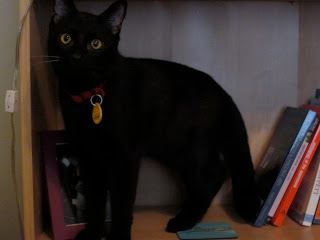
I have been contemplating adopting a cat for a long time. I started thinking about it almost as soon as I found out I had been accepted to UT Austin. I had to do some real thinking and planning, though, to make sure I could financially and emotionally support a cat. Now that I have, I already couldn’t imagine life without him (I’ve had him for two days.)
The final deciding factor was finding out about the program Austin Pets Alive!, an animal rescue service that takes cats from the local shelters’ euthanasia lists, boards them in kennels and foster care, and adopts them out to worthy families. Pets Alive! is an incredibly supportive adoption facility, and as a new pet owner, I feel so confident knowing I can contact their animal behaviorist with questions free of charge. They even pay for all of Gus’s shots, his neuter surgery, a microchip, and a month’s worth of pet insurance (which will be useful, as I was considering getting pet insurance, and this will be a great way to try it out.) They are a really, really great adoption service and I’m proud to have supported their efforts.
Gus is adjusting extremely well to his new home. So far, there has been an almost suspicious lack of problems. He uses his litter box just fine (even manages to be a relatively tidy litter user in spite of the fact that he has to spend 15 minutes interior decorating before each poo), he hasn’t scratched the furniture, doors, walls, or floor, and he isn’t too much of a nuisance at night. He likes to be near people, following me around the house (occasionally yowling to let me know I’m not paying proper attention to him). He’s not a lap cat, but he’s sleeping right next to me while I write this. He’s absolutely wild about chasing bits of string. I bought him one of those sticks with a feather at the end, and we happily played with it together for a solid hour and a half (and only stopped because I got tired.) I think my strategy to keep him entertained while I’m doing homework will be to balance his feather toy on the couch next to me so it dangles down and he can bat at it to his heart’s content without feeling neglected.
That's all for now. I’m sure in the future there will be many more Gus stories. He’s the only thing I talk about right now. I’m trying hard not to be annoying about it. Maybe this will get it all out of my system... Probably not.
Gus: The Theatre Cat
Gus is the Cat at the Theatre Door.
His name, as I ought to have told you before,
Is really Asparagus. But that's such a fuss
To pronounce, that we usually call him just Gus.
His coat's very shabby, he's thin as a rake,
And he suffers from palsy that makes his paw shake.
Yet he was, in his youth, quite the smartest of Cats--
But no longer a terror to mice and to rats.
For he isn't the Cat that he was in his prime;
Though his name was quite famous, he says, in its time.
And whenever he joins his friends at their club
(Which takes place at the back of the neighbouring pub)
He loves to regale them, if someone else pays,
With anecdotes drawn from his palmiest days.
For he once was a Star of the highest degree--
He has acted with Irving, he's acted with Tree.
And he likes to relate his success on the Halls,
Where the Gallery once gave him seven cat-calls.
But his grandest creation, as he loves to tell,
Was Firefrorefiddle, the Fiend of the Fell.
"I have played," so he says, "every possible part,
And I used to know seventy speeches by heart.
I'd extemporize back-chat, I knew how to gag,
And I knew how to let the cat out of the bag.
I knew how to act with my back and my tail;
With an hour of rehearsal, I never could fail.
I'd a voice that would soften the hardest of hearts,
Whether I took the lead, or in character parts.
I have sat by the bedside of poor Little Nell;
When the Curfew was rung, then I swung on the bell.
In the Pantomime season I never fell flat,
And I once understudied Dick Whittington's Cat.
But my grandest creation, as history will tell,
Was Firefrorefiddle, the Fiend of the Fell."
Then, if someone will give him a toothful of gin,
He will tell how he once played a part in East Lynne.
At a Shakespeare performance he once walked on pat,
When some actor suggested the need for a cat.
He once played a Tiger--could do it again--
Which an Indian Colonel purused down a drain.
And he thinks that he still can, much better than most,
Produce blood-curdling noises to bring on the Ghost.
And he once crossed the stage on a telegraph wire,
To rescue a child when a house was on fire.
And he says: "Now then kittens, they do not get trained
As we did in the days when Victoria reigned.
They never get drilled in a regular troupe,
And they think they are smart, just to jump through a hoop."
And he'll say, as he scratches himself with his claws,
"Well, the Theatre's certainly not what it was.
These modern productions are all very well,
But there's nothing to equal, from what I hear tell,
That moment of mystery
When I made history
As Firefrorefiddle, the Fiend of the Fell."
note: If you like this poem, be sure to check out Old Possum’s Book of Practical Cats!
What has this to do with anything? Well, one of the poems is called “Gus: The Theatre Cat.” And when I adopted a cat from the shelter yesterday, there was only one name suitable for him. Asparagus, or Gus, for short. (In the poem, you see, Elliot explains that Gus’s real name is “Asparagus” but that’s such a fuss/to pronounce that we usually call him just Gus.)
My Gus, the theatre cat even has a bit of an air of an Edward Gorey illustration about him. He’s all black except for striking yellow eyes and two white whiskers on the right side of his face. The whiskers, in particular, give him a certain... Gorey-ness.

Gus: The Theatre Cat
I have been contemplating adopting a cat for a long time. I started thinking about it almost as soon as I found out I had been accepted to UT Austin. I had to do some real thinking and planning, though, to make sure I could financially and emotionally support a cat. Now that I have, I already couldn’t imagine life without him (I’ve had him for two days.)
The final deciding factor was finding out about the program Austin Pets Alive!, an animal rescue service that takes cats from the local shelters’ euthanasia lists, boards them in kennels and foster care, and adopts them out to worthy families. Pets Alive! is an incredibly supportive adoption facility, and as a new pet owner, I feel so confident knowing I can contact their animal behaviorist with questions free of charge. They even pay for all of Gus’s shots, his neuter surgery, a microchip, and a month’s worth of pet insurance (which will be useful, as I was considering getting pet insurance, and this will be a great way to try it out.) They are a really, really great adoption service and I’m proud to have supported their efforts.
Gus is adjusting extremely well to his new home. So far, there has been an almost suspicious lack of problems. He uses his litter box just fine (even manages to be a relatively tidy litter user in spite of the fact that he has to spend 15 minutes interior decorating before each poo), he hasn’t scratched the furniture, doors, walls, or floor, and he isn’t too much of a nuisance at night. He likes to be near people, following me around the house (occasionally yowling to let me know I’m not paying proper attention to him). He’s not a lap cat, but he’s sleeping right next to me while I write this. He’s absolutely wild about chasing bits of string. I bought him one of those sticks with a feather at the end, and we happily played with it together for a solid hour and a half (and only stopped because I got tired.) I think my strategy to keep him entertained while I’m doing homework will be to balance his feather toy on the couch next to me so it dangles down and he can bat at it to his heart’s content without feeling neglected.
That's all for now. I’m sure in the future there will be many more Gus stories. He’s the only thing I talk about right now. I’m trying hard not to be annoying about it. Maybe this will get it all out of my system... Probably not.
Gus: The Theatre Cat
Gus is the Cat at the Theatre Door.
His name, as I ought to have told you before,
Is really Asparagus. But that's such a fuss
To pronounce, that we usually call him just Gus.
His coat's very shabby, he's thin as a rake,
And he suffers from palsy that makes his paw shake.
Yet he was, in his youth, quite the smartest of Cats--
But no longer a terror to mice and to rats.
For he isn't the Cat that he was in his prime;
Though his name was quite famous, he says, in its time.
And whenever he joins his friends at their club
(Which takes place at the back of the neighbouring pub)
He loves to regale them, if someone else pays,
With anecdotes drawn from his palmiest days.
For he once was a Star of the highest degree--
He has acted with Irving, he's acted with Tree.
And he likes to relate his success on the Halls,
Where the Gallery once gave him seven cat-calls.
But his grandest creation, as he loves to tell,
Was Firefrorefiddle, the Fiend of the Fell.
"I have played," so he says, "every possible part,
And I used to know seventy speeches by heart.
I'd extemporize back-chat, I knew how to gag,
And I knew how to let the cat out of the bag.
I knew how to act with my back and my tail;
With an hour of rehearsal, I never could fail.
I'd a voice that would soften the hardest of hearts,
Whether I took the lead, or in character parts.
I have sat by the bedside of poor Little Nell;
When the Curfew was rung, then I swung on the bell.
In the Pantomime season I never fell flat,
And I once understudied Dick Whittington's Cat.
But my grandest creation, as history will tell,
Was Firefrorefiddle, the Fiend of the Fell."
Then, if someone will give him a toothful of gin,
He will tell how he once played a part in East Lynne.
At a Shakespeare performance he once walked on pat,
When some actor suggested the need for a cat.
He once played a Tiger--could do it again--
Which an Indian Colonel purused down a drain.
And he thinks that he still can, much better than most,
Produce blood-curdling noises to bring on the Ghost.
And he once crossed the stage on a telegraph wire,
To rescue a child when a house was on fire.
And he says: "Now then kittens, they do not get trained
As we did in the days when Victoria reigned.
They never get drilled in a regular troupe,
And they think they are smart, just to jump through a hoop."
And he'll say, as he scratches himself with his claws,
"Well, the Theatre's certainly not what it was.
These modern productions are all very well,
But there's nothing to equal, from what I hear tell,
That moment of mystery
When I made history
As Firefrorefiddle, the Fiend of the Fell."
note: If you like this poem, be sure to check out Old Possum’s Book of Practical Cats!
Subscribe to:
Posts (Atom)